
Violas de Arame -- wire string Folk "Guitars" from Portugal and the Azores Islands -- FOR SALE
The word arame literally means "wire" in Portuguese, in this context it means metal strings. The word viola in Portuguese is used to refer to instruments which English and Spanish speakers would think of as "guitars", that is, fretted instruments with a flat back (as opposed to the bowl-shaped backs of the lute family), a long neck, and a waisted body (i.e, one which is roughly shaped like the number "8"). The term viola is usually used for the various folkloric instruments which are strung-up in multi-string courses, while the word violão (the augmentative form of viola) is often used for guitars which are strung-up with single-string courses such as the modern classical guitar.
There are a number of these interesting looking and sounding violas. Distinctive designs and tunings are associated with certain regions of continental Portugal, the Azores and Madeira Island. Portuguese immigrants in the US and Canada, often of Azorean descent, make and play these instruments. Over the last century there have been makers of these types of instruments in North America in New England, California, Quebec, Ontario and Brtish Columbia.
With enough time, I can import other types of violas and cavaquinhos from Portugal with my Portuguese guitarras which are made in northern Portugal.
At present I have the following instruments for sale.
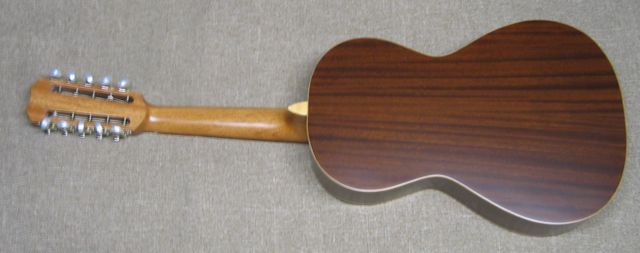
10-string Viola de Braga (also called Viola Braguesa) SOLD as off November 5, 2012
10-string Viola de Braga (also called Viola Braguesa). this instrument was made in nothern portugal ----SOLD
Price: $995 with custom hard shell case
Tuning is in 5-courses: cC, gG, aA, dd, gg (5th to 1st). This is like the Coimbra-style Portuguese guitarra tuning omitting the highest course.
This viola is typical of northwestern Portugal between the Douro and Minho Rivers.
Antique Viola da Terra--- SOLD
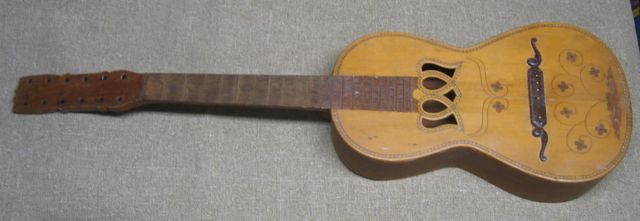

I am not sure where this instrument was made. I acquired it in Central California. I do not know if it was made by a Portuguese immigrant in North America, or whether it was made in the Azores, Madeira or Continental Portugal. It needs new tuning pegs, a nut at the head, and strings. The body is sound. It could use a coat of shellac or French Polished finish. It has some nice inlay on the face and a nice bridge. If you are interetsed in this instrument we should speak about your intentions.
15-string Viola da Terceira-with wooden tuning pegs-- In stock, this is an instrument made in Portugal in the 1990s.
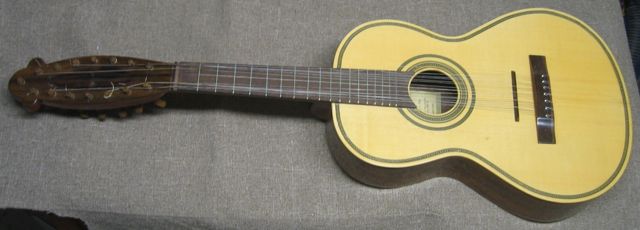

The nut on this instrument is 45mm. It has 15 strings. This nut design might be a bit cramped for most peoples hands. For someone with larger hands it might work better with only 12 strings. I had this instrument specially made with wooden pegs which look great but for me they are too much work. To be frank, it is very difficult to get all 15 strings in tune using wooden pegs. I personally have a lot of experience with wooden pegs on flamenco guitars (which use nylon strings), this instrument uses steel strings which are very sensitive to slight twists of the tuning pegs.
I have thought a lot about what to do with this viola da Terceira because of the difficulty of using wooden pegs. Unless I find some VERY experienced person who just must have an instrument with wooden pegs and who fully realizes what the difficulty is with wooden pegs, I think that the best situation is to have someone convert this wooden peg to banjo pegs. Such pegs cost $10 to $30 each. You can find them on ebay under banjo pegs. Then the pegs have to be installed. The installation involved filling the old peg holes with wooden dowels, then redrilling holes for the particular dimensions of the specific brand of banjo pegs. The present thickness of the head is 18mm. This is thicker than most banjo pegs are designed for, therefore this viola head must be sanded or plane down to about 9/16" or 19/32" (depending on the banjo peg design). To do this work it is necesary to have a drill presss and some experience with guitar repair and refinishing. It is not rocket science but it requires experience with woodworking and guitar repair; it is not a job for a beginner. I expect the cost of the pegs is between $200 and $300 and the labor is valued at $200 to $400. I do not want to do this work. I do not have a drill press and I have never installed banjo tuners. I could learn but I think there must be someone who wants this kind of instrument and can do the work themselves. Please inquire for the price and tell me where you are so I can calculate freight and tax.
This viola it has a hardshell case.
Tuning is in 6 courses: eeE, aaA, ddD, gG, bb, ee (6th to 1st)
The design of this viola with the airplane propellor is typical of the Azorean Island of Terceira, it was made in northern Portugal.
Please inquire by email about particulars:
Return to Fernandez Music Home Page