Kiwaya Ukuleles--Concert and Soprano (all-solid
wood) models)--
Fernandez Music, Anacortes, Washington, authorized dealer--
As of August 14, 2024 I only have a few models left...................
These are very well made, excellent sounding instruments made in Japan since 1919. I think these are wonderful instruments and I play mine (a Concert model with low G and another Koa Concert) everyday (yes, everyday). Ukuleles have been my private vice for a long time. (from Ron Fernandez).
There are 2 levels of Kiwaya Ukuleles: Ultra-thin laminated models (Eco Series) and the all solid wood Artist series.
For
several years I carried both the laminated and solid wood Kiwaya
Ukuleles. I have decided to only stock the all-solid wood models
(Artisan Series).
I have 4 models of Kiwaya Ukuleles in stock. Let me tell you about them.
All Solid Wood Kiwaya Ukulele Models (Artists Series)
The deluxe models Kiwaya Ukes feature solid Honduras Mahogany or golden Hawaiian Koa. These solid woods are properly dried and have excellent visual and acoustic quality. These 2 woods are the traditional woods used for great ukuleles. They are light weight and strong. Since the ukulele is intended to product sound in the higher frequencies ("treble" notes) rather and then low frequencies (bass notes), the choice of a medium density wood is the right wood to use. I should mention here that classical guitar need dense woods for the back and sides because they aim to produce low frequencies (i.e., bass notes) as well as higher frequencies which are largely produced by the softwood soundboards. This difference between the small body uke and the larger body nylon string guitar is good to keep in mind. In my opinion, it is a mistake to make a ukulele with a dense wood back because the soundbox is not large enough to amply the frequencies which are associated with dense woods such as Brazilian or Indian rosewood.
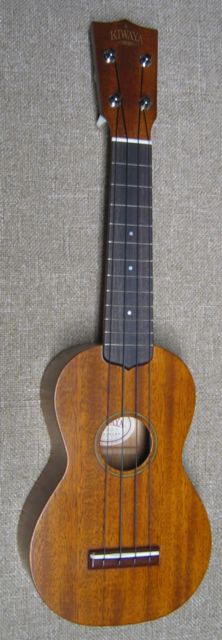
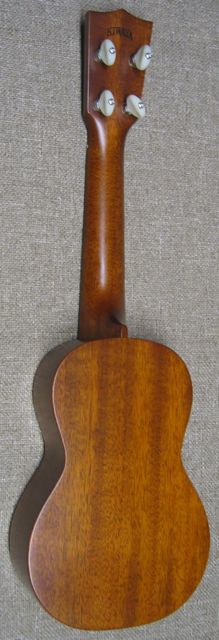
Above: Kiwaya Uke KTS-4, standard Soprano Size, 12 frets, Solid Mahogany, Indian Rosewood fingerboard, 3 larger dots on fretboard, no dots on fingerboard edge, Deluxe Nickel Plated Gotoh Tuners, 2 back braces, 2 harmonic face braces (one above and one below soundhole) and 2 fan struts under the face, real bone nut and compensated bone saddle. List price $675 December 1, 2020). You can see a video of this model in an unlisted section of YouTube at: https://www.youtube.com/watch?v=ukDv-_DXq38

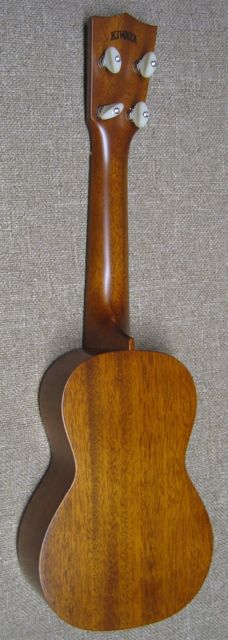
Above: Kiwaya Uke KTS-5, standard Soprano Size, 17 frets, Solid Mahogany, Indian Rosewood fingerboard, 7 larger dots on fretboard, 5 dots on fingerboard edge, Deluxe Nickel Plated Gotoh Tuners, 2 back braces, 2 harmonic face braces (one above and one below soundhole) and 2 fan struts under the face, real bone nut and compensated bone saddle, List price is $775 (in stock as of December 1, 2020). Call for price, I do not quote by email.
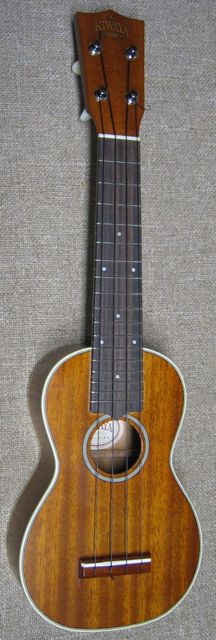
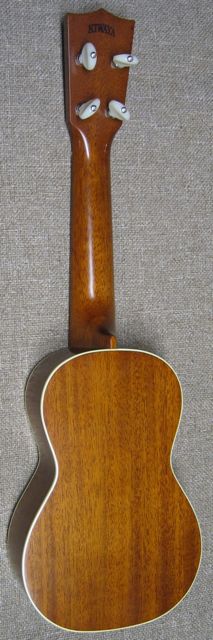
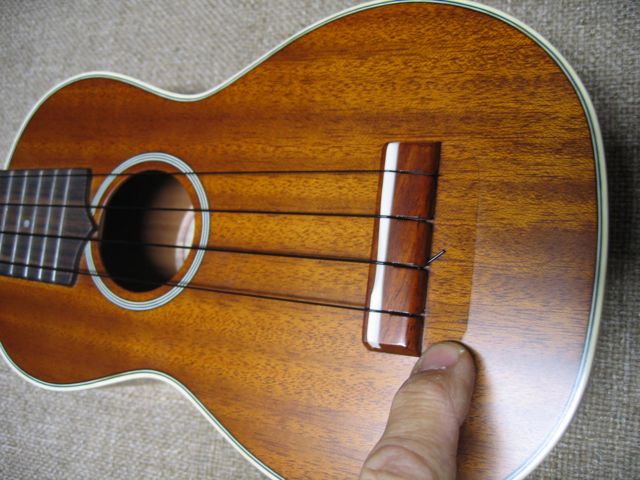
Above:
Kiwaya Ukulele, model KTS-6, Soprano size, 17 fret, all solid
wood,
Honduran Mahogany Body, Indian Rosewood fingerboard, compensated
bridge, bone nut and saddle, ivoroid binding aound the face
decorated
with a black line, ivoroid binding around back, deluxe rosette
inlaid,
Deluxe Gotoh Nickel plated tuners, 7 larger dots on fretboard, 5
dots
on edge of fretboard, 2 braces across the back, 2 harmonic
braces
across the face (one above and one below the soundhole, 2 fan
style
stiffing struts under the face. The 3rd photo above shows the
clear
plastic string guard which I can add upon request. SOLD OUT.
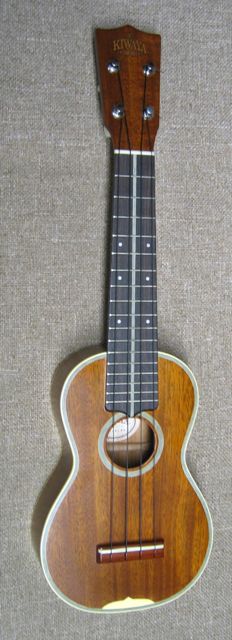
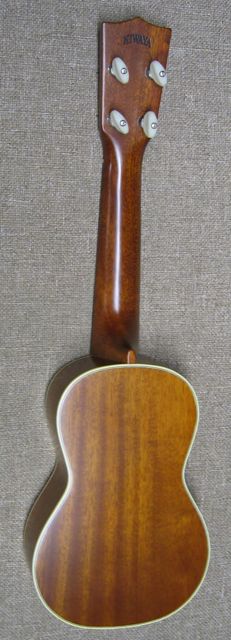
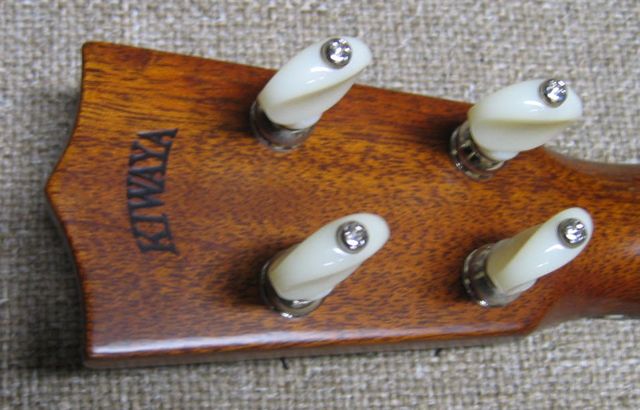
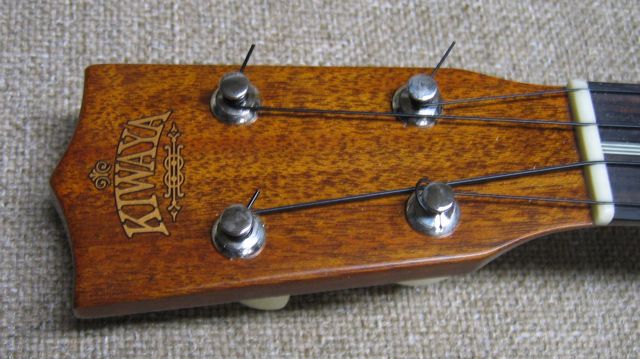
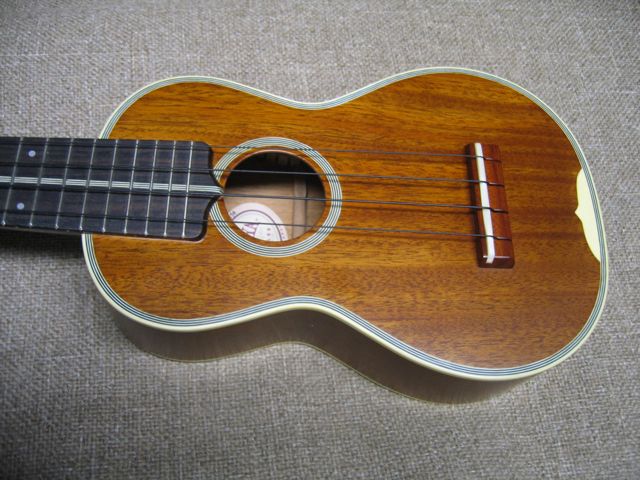
Above:
Kiwaya Uke KTS-7, Soprano Size, 17 fret, Solid Honduras
Mahogany,
Indian Rosewood fingerboard, 6 larger dots on fretboard, 5 dots
on
fingerboard edge, ivoroid binding on front with 3 black lines,
ivoroid
binding on back with 1 black line, 3 white veneers in the cnter
of the
fretboard, ornamental ivoroid on face at base, Deluxe Nickel
Plated
Gotoh Tuners, 2 back braces, 2 harmonic face braces and 2 fan
strut
under the face, real bone nut and compensated bone saddle. These
are
rare, the workshop makes a limited number of these. List price
was
$1345. I have put this one in my private reserve and is not for
sale at
this time.
All Solid Wood Concert Size Ukuleles (Artist Series)
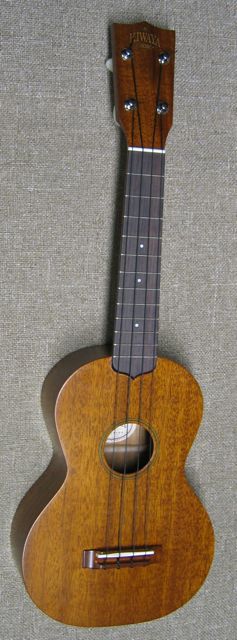
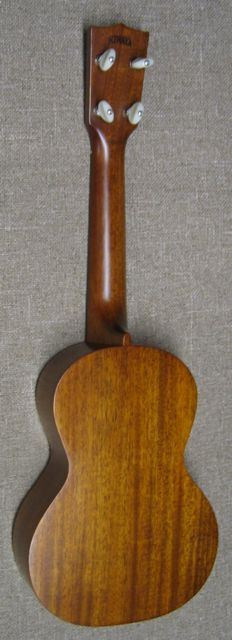

Above:
Kiwaya Concert Size Uke, KTC-1, 12 fret, Solid Mahogany,
Rosewood
Fingerboard, 3 dots on fingerboard, real bone nut, real bone
compensated saddle, inlaid circle around rosette, Delux Gotoh
Nickel
Tuners, neck joint body at 12th fret. This Uke shown with
standard,
high G for 4th string. List price is $815 (Out of Stock as of
December 1, 2020
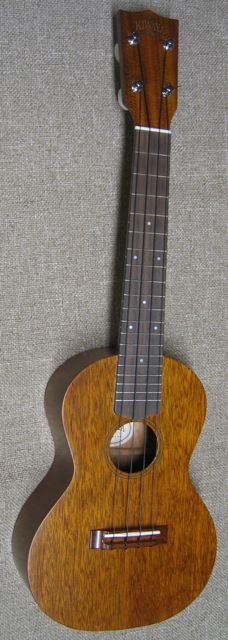
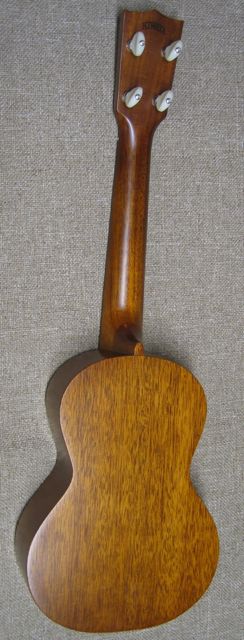
Above:
Kiwaya Concert Size Uke, KTC-2, 19 fret, Solid Mahogany,
Rosewood
Fingerboard, 7 dots on fingerboard, 5 dots on fingerboard edge,
real
bone nut, real bone compensated saddle, inlaid circle around
rosette,
Deluxe Gotoh Nickel Tuners, neck joint body at 12th fret. List
price is
$925 (in stock December 1, 2020).

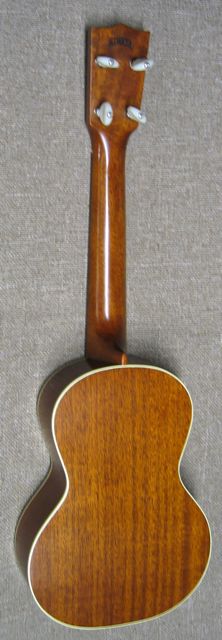
Design Features of Kiwaya Ukuleles. If you appreciate quality in construction, sound and playability, please read the information below.
The compensated saddle. For reasons which mainly involve the thickness of different strings and how they vibrate, thicker strings of given material (e.g., nylon, polycarbonate, or wire over nylon filaments) must have a slightly longer length that a thinner string. On classical guitar you can see that the saddle is slanted so that the 1st string has a shorter length than the 3rd string. This slight slant gives more accurate intonation. Most ukuleles do not have a "compensated brdge" or "saddle". The Kiwaya refine the tuning of their ukuleles by slightly lengthening certain strings by shaping the bone saddle. You can see in the photo below that the 2nd and 3rd string rest on a bone saddle which is cut so that those strings are slightly longer than the 1st and 4th string.
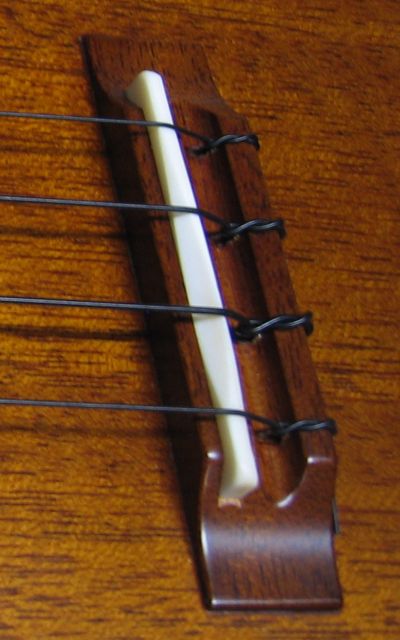
Above: Compensated Saddle on KTC-1
Quality Gotoh tuners. These are good functional tuners. They keep the string held tight. Also they are adjustable (i.e., you can tighten then with a small Phillips head screw driver). There are standard grade which have good mechanisms and opaque white knobs. The Deluxe Gotoh tuners have a better mechanism and higher quality knobs.
Fret placement. The frets are acurately placed using the modern even-tempered method to calculate fret placement. The modern method is based on calculating the fret size with a mathematical factor based on the 12th root of 2. This is a number multiplied times itself to equal 2. The number is about 1.0594631. This number allow the placement of frets with a system that makes each fret smaller by about 5.9% and it places the 12th fret at the mid point of the string length. If you are interested in understanding this fret placment rule, see Hideo Kamimoto's wonderful book entitled, Complete Guitar Repair, pages 54 through 64.
Bridge and Saddle placement. The bridge and the saddle in the bridge is properly placed so the intonation is accurate. This is important. Sometimes ukuleles made by inexperienced factories have a bridge which is not placed correctly; this is very frustrating to a player who may not understand why her uke doesn't sound right.
Bridge centered in lower bout. Here is a design feature I noticed which is very subtle--the bridge is placed as close as possible in the center of the lower bout. From my long experience with high end Spanish guitars I know that this is important for good sound. You will notice that the bridge is placed slightly differently for the KTC-1 amd KTC-2, this is because one is a 12-fret instrument and the other is a 19-fret instrument.
Light Weight. These instruments are very lightweight. They only weigh 12 to 13 oz. They feels good to play. You can feel how they vibrate. They do not have excess weight which restricts the soundbox from vibrating. Also, these ukes are balanced properly so the body and neck feel right--it is not top heavy or bottom heavy.
Fret Material. The frets are of a good material called "nickel-silver", not cheap brass frets which wear and tarnish more quickly. The frets are a size appropriate for ukuleles. I often see mass produced ukes which have frets which are too wide for the small fretboard. Note: "nickel-silver" is a commercial alloy it does not contain any silver.
Finishes. The finish used on Kiwaya ukuleles is thin but durable. It is thick enough to protect the instrument but does not restrict the vibration of the wood.
Sizes. The Concert Uke is slightly large than the soprano uke. The lower bout of a concert is 7-3/4", the body length is 10-3/4", body thickness is 2-1/2", where as lower bout of a soprano is 6-5/8", 9-12", and 2-7/16" bdoy depth. the The string length from nut to saddle is a nominal 15" (while a soprano is 13-3/4").
Tunings. Both the soprano and concert ukes are commonly tuned G, C, E, A (from 4th to 1st string). The soprano is sometimes tuned a step (i.e., 2 frets higher) so it is A, D, F#, B. In these tunings the 4th string is tuned one octave above what would be expected, that is, it is tuned to the 3rd fret of the 2st string. There is also a "Low G" tuning where the 4th string is tuned an ocatve below the 3rd fret of the 2nd string; for the low G tuning it is best to use a wound string rather than a simple nylon string . I like the Low G tuning for the Concert Size Uke but I prefer the standard Uk tuning for the soprano. If you play the guitar, you may realize that the G,C,E,A tuning is like the 1st four strings of the guitar when it is barred or capoed at the 5th fret. If you think about this the fingering for chords will make sense.
Dimensions. Soprano, 347mm (13-11/16") scale, Concert 385mm (15-1/8") scale, Tenor 435mm (17-1/8" scale). Soprano and Concert 35mm (1-7/16") nut width, Tenor 36mm nut width (1-1/2"). 1st to 4th string at nut = 29mm, 1st to 4th string at bridge is 40mm
Ukulele Bags and Cases
We have simple gig bags, padded gig bags and hard shell cases for Soprano and Concert Kiwaya Ukulele. These items are not included in the price of the ukulele.
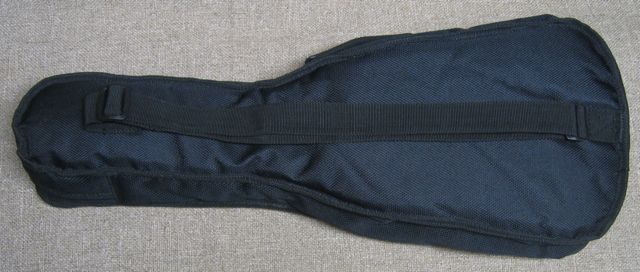
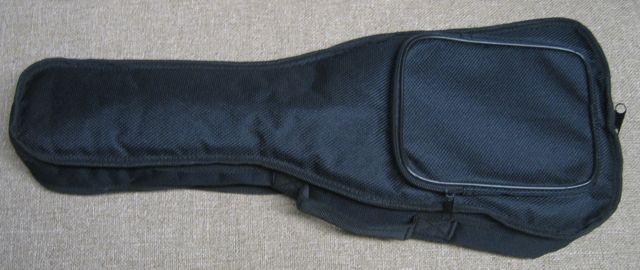
Above: Gig bags for soprano, with outside pouch, and shoulder strap, black only. $29
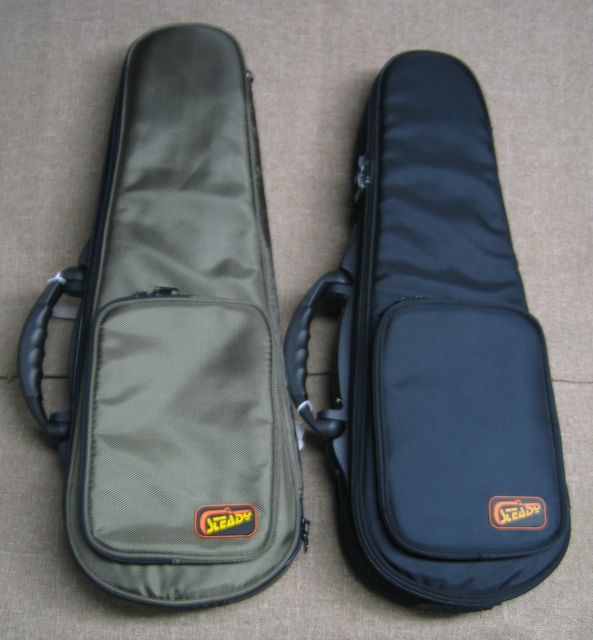
Above:
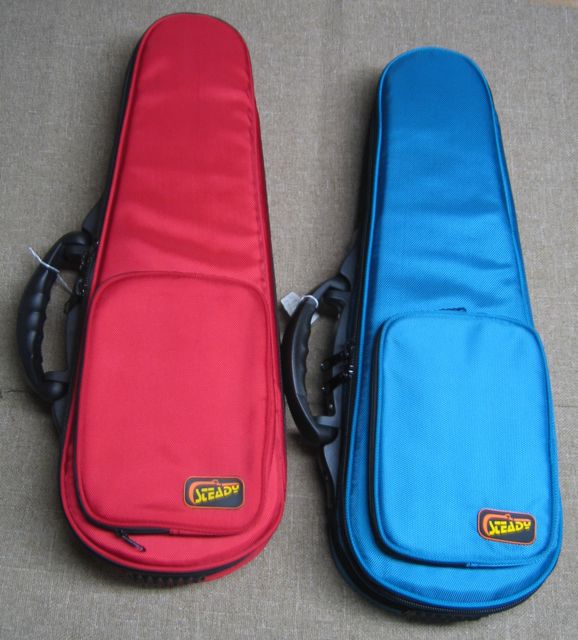
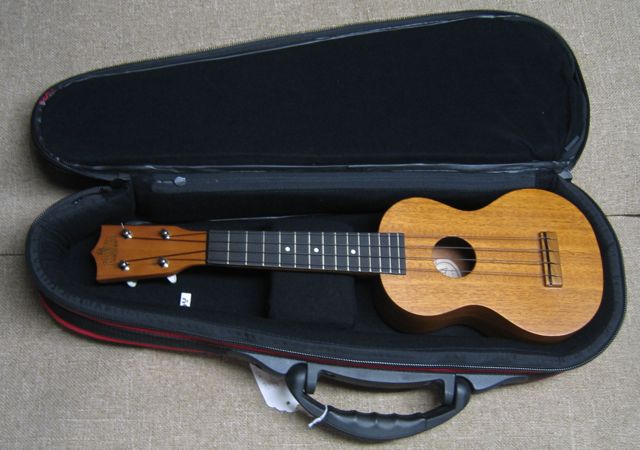
Deluxe Padded Gig bags are $55 for the Soprano Ukes. They are
made of a
strong nylon, have an outside pouch (for strings and things) and
a
carrying strap. For the soprano ukes, we have a variety of
colors (red,
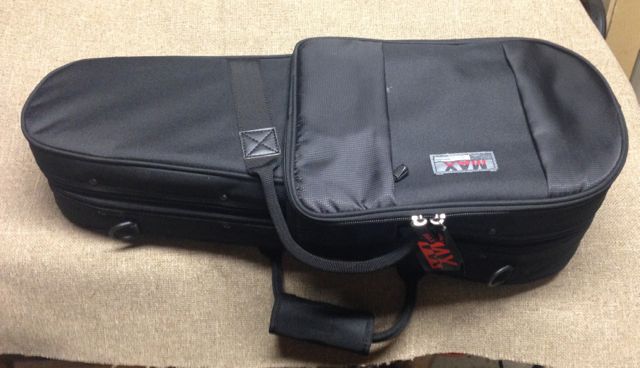
green, blue, and black). For a padded Concert bag we have
some in
black by Protec.
Protec Ukulele cases.
I have these hard foam core cases for soprano, concert and tenor ukes. I sell these only with instruments I sell. These are lightweight but very protective case. I put $10,000 guitar in the guitar version of this case and ship them world wide. I very much like that this case because it closes with a zipper instead of metal luggage hardware which can dmage the instrument. These cases also have a roomy pouch on the outside and shoulder straps. They list for: $75for soprano, $75 for concert $75 for tenor. With the purchase of any of my ukes I will give a discount. I do not sell the cases by themselves.

Why I sell Kiwaya Ukes
As a small child I was given a uke in the early 1950's by my Great Uncle Julio during the Arthur Godfrey ukulele craze. I only became completely intrigued decades later during the 1990s when I started to attend the ukulele sessions at the Oasis Center in Corona del Mar, California. I believe that this group was started in 1980 by Jack Toon. Each week for a few years at the Oasis, I played with players who (at the times) were 30 to 50 years older than I. We sang Hawaiian songs and watched the senior citizen ladies dance the hula; we sang through a large collection of songs which included great standards from the turn of the century, vaudeville, stage shows and movies tunes; and we performed at community function, retirement homes and shopping centers. With this dear group of people I internalized this music while we strummed the chords and had a community singalong (an almost forgotten American tradition). While I often watched seniors struggle through playing a few chords, I also got to watch talents like the late great Travis Harrelson and the 102 year old Bill Tapia weave their magic using this deceptively simple instrument. It became abundantly clear to me (who had studied classical and flamenco guitar for decades) that the uke was more than a toy--it was a magical, intimate musical device.
During this intense indoctrination into ukulele culture I acquired a great vintage Martin Soprano model 1 and a fine Martin Tenor. Owning and playing these instruments helped refined my understanding of great ukes. I was able to learn first hand what tone and projection are for a fine ukulele. While a cheap uke sounds muffled, a good ukulele sings out. A cheap uke feels heavy, a good uke feels vibrant. A fine ukulele has good (accurate) intonation, a poor one does not. I could try to explain more of this but the real proof is in handling, playing and listening to a bunch of ukes.
If you have any questions, email me: ron@fernandezmusic.com
My phone number in Anacortes, Washington is 949 856 1537
Return to Fernandez Music Home Page