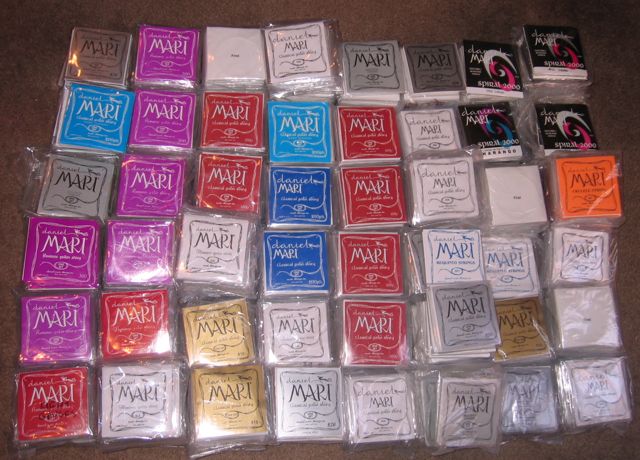
Over the last 50 years I have used many brands of strings from the USA, France, Argentina, Italy, Brazil, and Germany). I know of only one real string maker in Spain. I have used Daniel Mari strings (New York) in my workshop since the 1990s.
Since it takes as much time to send several set of strings as it does one set and the shipping cost is the same, I offer classical, flamenco or requinto strings at the low price of 4 sets for $36 including shipping in the USA. I will mix the sets so you can order some of each classical or flamenco sets.
If you want to buy strings we accept PayPal for payment to: ron@fernandezmusic.com
If you email me please tell me where you are. We are in Anacortes, Washington. We see clients by appointment only.
Contact me before you send a check or money order. I have a large stock of these strings but please contact me first.
--------------------------------------------------------------------------------------------------------------------------------------------------------------------------------------------------
I have 3 types of Classical Guitar strings sets: Medium (out of stock) and High tension (silver), Medium Tension Bronze. I suggest Medium tension for most Spanish Guitars
I have 1 tension of Flamenco Guitar strings: standard flamenco; this tension is slightly less than the medium tension classical strings. This is the tension I personally use on my private flamenco guitars. Flamenco strings are not some magically different type of string. They are simply lighter gauge classical strings.
I have various specialty strings: requinto strings, charango strings, Venezulan cuatro strings, Tres Cubano strings, Laud, Bandurria strings. These are $36 for 4 sets including shipping in the US.
When I first met Daniel Mari in the 1990's I asked him about gut strings for lute and antique guitars. He then started to explain in great detail how he made them . He said. "We use to buy the lamb intestine at the slaughter house, we would treat the guts in a solution, use a special sharp hook to divide the gut into 4 sections, we would use the top of the section for viola strings and the bottom for violin strings, we would twist the gut in a special way, and hand polish them."
I was impressed by his explanation and pleased because I realized that this man was that rare person--a genuine expert in his field. I soon found out that his family has been making string in Italy since 1600! His uncle and father came to New York in 1900 where then helped dig the subway. When they had saved enough money they started making gut strings and selling them to Wurlitzer. Daniel immigrated to the US after the Second World War and joined in the string making company. E & O Mari (aka La Bella). His sister's side of the family wound up with the La Bella trademark and Daniel has been making strings under his name for many years. His personal story is central to the evolution of string making in the United States. He had made strings for Sabicas, Mario Escudero, John Lennon, Leo Fender, Les Paul and many others.
For years Daniel has been making private labeled
strings and strings for instrument manufacturers around the
world. He is a supplier to musical instrument manufacturers
rather than a retail marketer
I have put Daniel Mari strings on thousands of guitars that I have imported from Spain, Portugal and Latin America. I personally use Daniel's strings on my Miguel Rodriguez flamencos, Felix Manzanero classical and flamencos, Eugene Clark, John Park and my own guitars. I use them on my private collection of ethnic instruments too--Bolivian charangos, Portuguese guitarras, Venezuelan cuatros, Martin Ukuleles and Tres Cubanos.

Mari Classical Strings 100p are professional grade, medium tension strings with silver coated basses and clear trebles. These are the strings I put on Esteve, Manuel Adalid and Juan Hernandez Classical guitars when I restring them in my shop. I find that that this tension produces a full sound. In technical terms it produces good fundamentals and upper partials. These are the strings I generally recommend to everyone. 4 sets for $36 including shipping in the US
Mari Classical Strings 200ph are
professional grade high tension, silver coated basses with clear
trebles. 4 sets for $36, shipping included in the US.
Mari 810 Classical Strings. These are Medium tension sets with Bronze basses and clear treble. These have a different sounds than the silver coated basses. 4 sets for $36 including shipping in the US
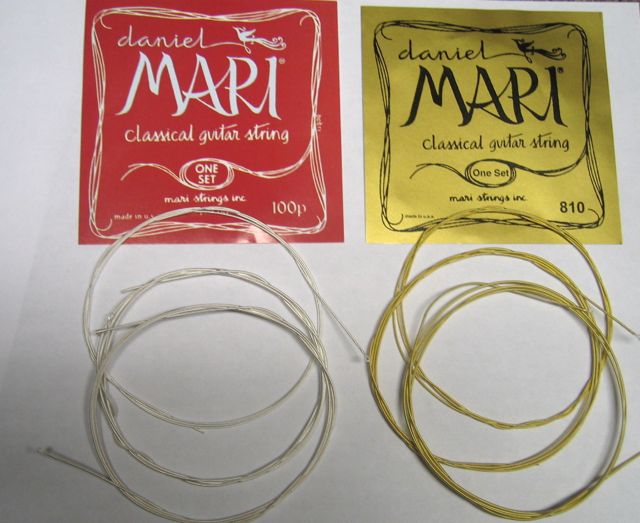
This photo show the silver coated bass trebles of the 100p and 200ph and the bronze bass strings of the 810.
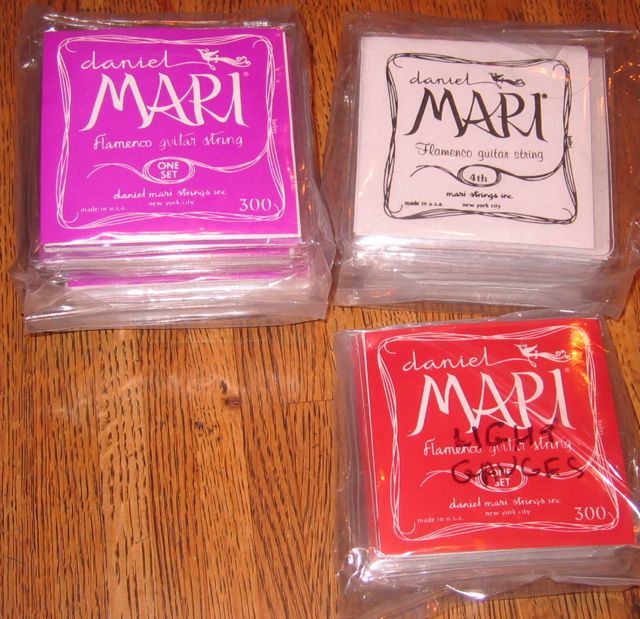
Mari Flamenco Strings. Standard
tension. These are lower tension than the Mari Medium Tension
classical strings. Silver basses, clear trebles. These are what I
use on Esteve 5F, 6F, 8F, 9F and 11F, Vicente Sanchis, Juan
Hernandez Profesor Flamenco and Juan Hernandez Professional
Flamenco Guitars. I also use them on my Felix Manzanero and Miguel
Rodriguez Guitars. 4 sets for $36 including shipping in the US
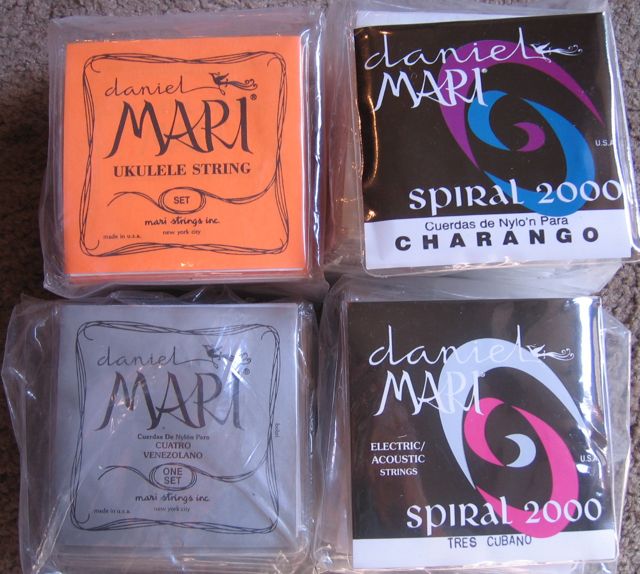
Mari Ethnic Strings. I stock various strings for ethnic fretted instruments such as Bolivian Charango, Tres Cubano, Cuatro Venezolano, Standard Ukulele and Tenor Ukulele.
If you want to buy strings we accept PayPal for payment to: ron@fernandezmusic.comIf you email me please tell me where you are. We are in Anacortes, Washington. We see clients by appointment only.
Contact me before you send payment. I have a large stock of these strings but please contact me first.
------------------------------------------------------------------------------------------------------------------------------------------------------------------
Some thoughts about the projection and fullness of guitar strings by Ron Fernandez
I use to think that high tension strings would always produce a louder sound than medium tension strings. I now think that the matter is more complex. One reason is that the audience and the player hear different sounds. So, the question becomes: louder for whom?
The player hears more of the fundamental notes and the audience hears more of the upper partials (what some people call "harmonics"). The fundamental and the upper partials travel at different rates. What does this mean? What is a "fundamental" and what is an "upper partial". Let me give an example.
When you pluck the 5th string of a guitar it produces a frequency of 110 cycles per second, that is, the strings vibrates 110 times in a second and produces the note "A" (its technical name is A2). If the soundboard has the right flexibility and the string is the right thickness, the string will also segment into 2 parts (at about the 12th fret) and each of the 2 segments will vibrate at 220 cycles per second at the same time that the entire string is vibrating at 110 cycles per second. The note produced by a frequency of 220 cycle per second is an "A" (its technical name is A3 which is one octave above the fundamental note "A" ( whose technical name is A 2 at 110 cycles per second). If the soundboard has the right flexibility and the string is the right thickness, it will also segment into 3 parts each of which will produce a frequency of 330 cycles per second which is the note "E" ( whose technical name is E4 which is a fifth about the A3 at 220 ycles per second). [This explanation may be boring or difficult for some readers but it is worthwhile to continue.] If the soundboard has the right flexibility and the string is the right thickness it will segment into 4 parts which will produce another "A" at 440 cycles per second (which is Concert Pitch "A", which is called A4 which is the same note as the "A" on the 1st string at the 5th fret. The string can also segment into 5 parts and produce a note at 550 cycles per second, which is close to the note C#. The string might also segment into 6 parts and produce another "E" at about 660 cycles per second (the technical name of this note is E5 which is at 659.26 of an even tempered scale. The string might also segment into 7 parts and produce a note at 770 cycles per second which is close to a G5 at 783.99 of the even tempered scale. And it might segment into 8 parts which will produce another "A" (A5 at 880 cycles per second).
What this means is that the single 5th string can segment and produce an A7 chord (A, C#, E, G). However, If the string is too tight, it cannot segment and will not produce such a full series of notes and will not seem to have such a "full" tone. What this means to the player is that you must find strings which suit the flexibility/stiffness of your guitar.
Furthermore, higher frequencies travel further than lower frequencies. In every day life you know that you can hear a baby scream across the room but it may be difficult to hear a man with a deep voice. This is because the scream of the baby is a higher frequency which travels further and with less energy than a lower frequency. The implication for a guitarist performing without amplification is that the audience hears more of the upper frequencies (i.e., the upper partials) while the player is surrounded by lower frequencies (i.e, the fundamental notes). So, if you are going to test the projection and "volume" of a guitar you must not simply listen from behind he guitar but you must have someone else play it so you can listen to it yards in front where the audience would be.
To recap: whether the guitar will produce a louder sound with medium or high tension strings depends greatly upon the flexibility or stiffness of the soundboard on a particular guitar. If the string tension is too hard for the particular soundboard then the strings will not be able to segment enough to produce the upper partials. In short, higher tension does not guarantee a louder sound or strong projection. High tension strings are harder to pluck but they return to playing position slightly faster than a lower tension string--they feel stiffer to the player. You might like how higher tension strings feel if you are playing polyphonic music and you want the strings to return to its original position more quickly but they will be stiffer/harder for your fingers And, they will not necessarily sound louder or fuller to the audience.